
Blog Post
Top-Rated Best Betting Sites in the World for Sports Betting and Casino Games
The online betting industry has grown rapidly over the last decade, giving bettors access to thousands of sports markets, casino […]
Published 14 July 2026 Updated 2 November 2026
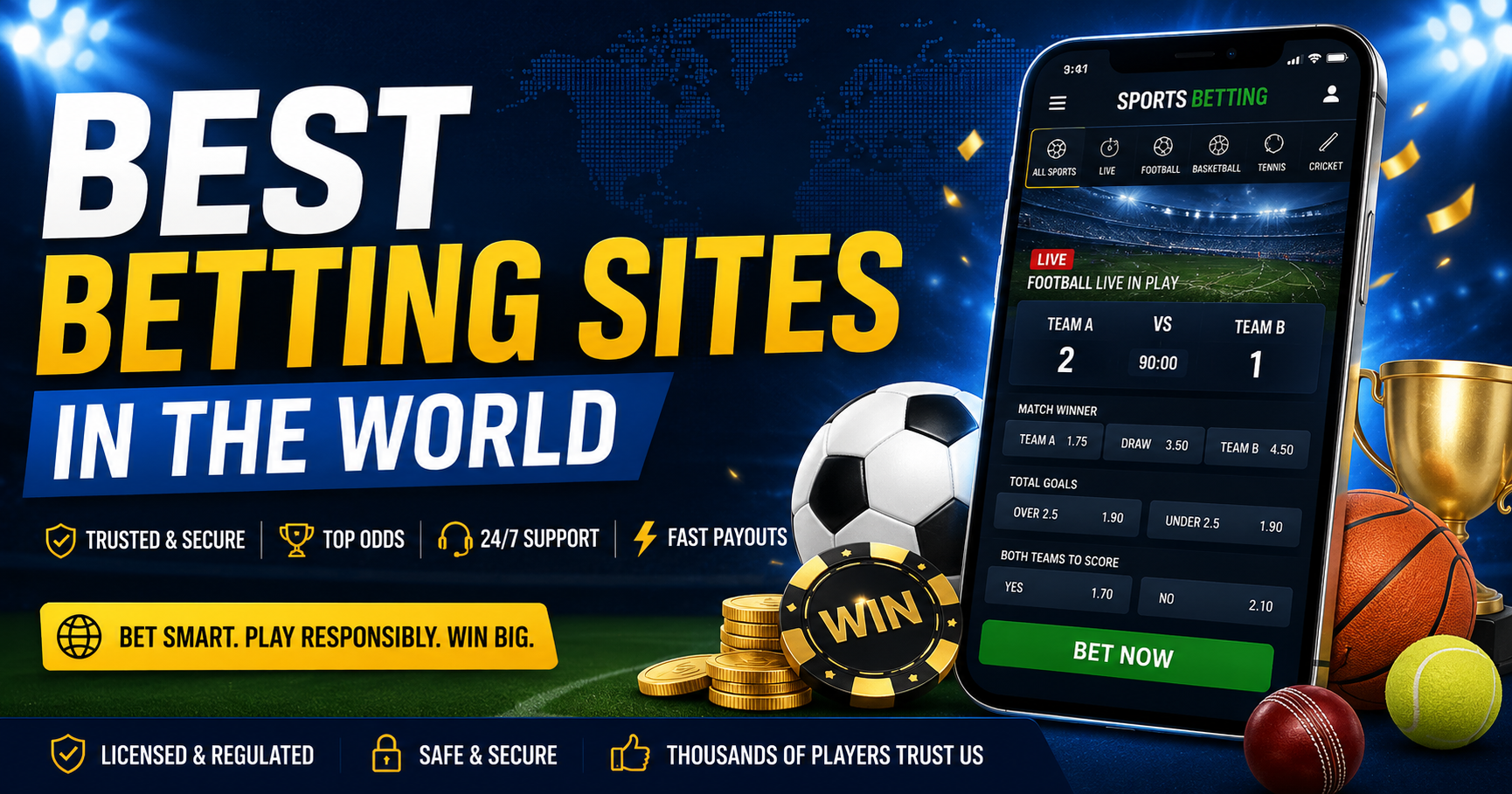
Best Betting Sites in the World: Features, Security and Regulations
The online betting industry has changed significantly over the past decade. Today, digital platforms cover many sports, live events and interactive services. They also use modern payment systems and mobile technology.
Many people search for the best betting sites in the world to learn about international sportsbooks. They want to understand available sports, website features, payment options and security measures.
However, choosing a website requires more than comparing promotional offers. Visitors should also examine the company’s identity, licensing status, payment policies and customer support. Most importantly, they should understand the laws that apply in their country.
Not every website operates under the same rules. A platform may hold a licence in one country but lack permission to provide services elsewhere. Therefore, international availability does not automatically mean legal authorisation.
This guide explains how international sportsbook websites work. It covers sports categories, market terminology, mobile features, payment systems and website security. It also discusses responsible gambling and important legal considerations.
Understanding the Global Online Betting Industry
An online sportsbook is a digital platform that provides information and markets related to sporting events. Depending on its business model and legal permissions, it may cover football, cricket, tennis, basketball and other sports.
The industry includes companies operating under different licensing systems. Their services, payment options and geographical restrictions can vary.
Several developments have shaped this industry.
Digital Sports Coverage
Sports fans now access match information through websites and mobile applications. They can check fixtures, follow scores and read player statistics from different locations.
Some sportsbook websites also display similar information. As a result, sports coverage and interactive digital services often appear together.
Mobile Technology
Smartphones have made sports-related websites easier to access. Visitors can view match information, check account details and read website policies on smaller screens.
However, mobile access does not prove that a platform is secure or legally authorised.
International Sporting Events
Major sports competitions attract audiences from around the world. Football leagues, international cricket tournaments and professional basketball competitions generate significant online interest.
Many websites organise their information around these events. However, the available coverage depends on the operator, data provider and local regulations.
How to Evaluate International Sportsbook Websites
There is no single worldwide ranking that identifies the best betting sites in the world. A platform’s legal status and operating standards depend on its company, services and jurisdiction.
Instead of relying on promotional claims, readers should examine several important factors.
1. Company Information and Ownership
First, identify the organisation operating the website.
A reliable assessment should consider:
-
Registered company name.
-
Business registration information.
-
Country of operation.
-
Official contact details.
-
Website ownership information.
-
Published terms and conditions.
A familiar brand name does not always identify the legal company behind a website. Different domains may also use similar names.
Therefore, check the operating company’s identity before relying on information published on the website.
2. Licensing and Regulatory Information
Gambling regulations differ between countries. Some jurisdictions require operators to obtain specific licences before providing gambling services.
Important licensing details include:
-
Licence number.
-
Name of the issuing authority.
-
Licensed company name.
-
Approved activities.
-
Licence validity.
-
Geographical restrictions.
A website may display a licence logo or number. However, this does not prove that the information is genuine.
Visitors should check licensing details through the regulator’s official website.
For example, the UK Gambling Commission maintains a public register of licensed gambling businesses.
Official website: https://www.gamblingcommission.gov.uk/
3. Terms and Conditions
Terms and conditions explain how a digital platform operates.
They may cover:
-
Account eligibility.
-
Identity verification.
-
Privacy requirements.
-
Payment conditions.
-
Dispute procedures.
-
Market definitions.
-
Account restrictions.
-
Applicable laws.
Readers should examine these documents before relying on any service.
Clear terms make it easier to understand the responsibilities of the company and its visitors.
4. Customer Support
Customer support is another important part of a digital service.
A website should clearly explain how visitors can contact its support team. It should also identify the official communication channels.
Be careful with unofficial social media accounts. Some may impersonate company representatives.
Furthermore, the presence of a customer support page does not automatically prove that a business is trustworthy.
Sports Coverage on International Digital Platforms
Sports coverage is one of the main features associated with international sportsbook websites.
Different platforms may display different competitions and sporting categories. The following sections explain some commonly covered sports.
Football
Football has a large international audience. Professional leagues, continental tournaments and national competitions attract attention throughout the year.
Popular competitions include:
-
English Premier League.
-
UEFA Champions League.
-
La Liga.
-
Serie A.
-
International football tournaments.
Sports-related market terminology may include:
-
Match result.
-
Total goals.
-
Handicap.
-
Correct score.
-
Half-time result.
-
Player statistics.
-
Match events.
Each category has its own meaning. Availability also depends on the platform and applicable regulations.
Cricket
Cricket is particularly popular in South Asia, Australia, England and several other regions.
International matches and franchise competitions generate extensive sports coverage.
Some major competitions include:
-
ICC Cricket World Cup.
-
ICC T20 World Cup.
-
Indian Premier League.
-
Bangladesh Premier League.
-
Pakistan Super League.
-
Big Bash League.
-
The Ashes.
Common cricket terminology includes match results, innings totals, batter statistics, bowler statistics and tournament results.
These terms describe different types of sporting information. They should not be treated as reliable predictions of future results.
Tennis
Professional tennis competitions take place throughout the year. They include tournaments organised by the ATP and WTA, as well as the four Grand Slam events.
Tennis coverage may include:
-
Match results.
-
Set scores.
-
Service statistics.
-
Break points.
-
Aces.
-
Double faults.
-
Player rankings.
These statistics help readers understand player performance. However, previous results cannot guarantee future outcomes.
Basketball
Basketball coverage includes professional leagues and international competitions.
The NBA and EuroLeague are two widely followed examples.
Common basketball terminology includes:
-
Moneyline.
-
Point spread.
-
Total points.
-
Quarter results.
-
Player statistics.
Different competitions may use different rules and match durations. Therefore, statistical information should always be interpreted in its proper context.
Other Sports
International sports websites may also cover several other categories, including:
-
Baseball.
-
Ice hockey.
-
Rugby.
-
Boxing.
-
Mixed martial arts.
-
Golf.
-
Volleyball.
-
Motor racing.
-
Horse racing.
-
Esports.
However, the presence of these categories does not mean that every website can legally offer related wagering services in every country.
Understanding Common Sports Market Terminology
Sports markets describe particular sporting events or statistical outcomes.
Although some terms appear across different sports, their definitions may vary.
Match Result
A match result refers to the outcome of a sporting event.
Depending on the sport, the final result may include a win, loss, draw or tie.
Some competitions also use extra time, overtime or other procedures to determine a winner.
Handicap
A handicap applies a numerical adjustment to a team’s or participant’s result.
Different sports use different handicap systems. Therefore, readers should understand the specific market definition rather than assuming that all handicap categories work identically.
Total Goals, Runs and Points
These categories describe scoring within a match or a particular period.
For example, football uses goals, basketball uses points and cricket uses runs.
The relevant measurement depends on the sport and market description.
Player Performance
Some digital platforms display information about individual athletes.
Examples include goals, assists, runs, wickets and points.
These statistics describe recorded sporting performances. Their definitions should be checked against the relevant competition records.
Full Tournament Results
Tournament-related information focuses on the overall competition.
It may include team standings, qualification rounds, elimination stages and championship results.
This information is useful for understanding how a competition develops over time.
Live Sports Data and In-Play Information
Live sports information allows visitors to follow events while they are happening.
Digital scoreboards can update match details throughout a competition.
For example, football coverage may show goals and substitutions. Cricket scorecards display runs, overs and wickets. Basketball services may show quarter scores and player statistics.
However, live information can have limitations.
Data Accuracy
Different websites may display slightly different information at the same time.
This can happen because of delays in data transmission or technical problems.
For completed matches, official competition records provide an important reference.
Market Suspension
A live market may become temporarily unavailable during an important match event.
For example, a website may suspend a market following a goal, wicket or injury.
This allows the platform to update its information and apply the relevant rules.
Event Settlement
Settlement refers to the process of assigning a final status to a market under its published conditions.
The official sporting result and a platform’s settlement decision are related but separate matters.
As a result, readers should not assume that different websites always use identical settlement rules.
Mobile Compatibility and Website Accessibility
Mobile technology has made sports-related websites easier to access.
However, a good mobile experience requires more than displaying a smaller version of a desktop website.
Responsive Design
A responsive website adjusts its layout to different screen sizes.
Menus, tables and text should remain readable on smartphones and tablets.
Loading Speed
Page speed affects how quickly visitors can access website information.
Large images, unnecessary scripts and poorly optimised resources may slow down a website.
Accessibility
Accessible design helps people with different abilities use digital services.
Important features include:
-
Readable text.
-
Clear colour contrast.
-
Keyboard navigation.
-
Descriptive labels.
-
Consistent page structure.
These improvements make websites easier to understand and navigate.
Account Protection
Websites that collect personal information should explain their account security procedures.
A modern design or mobile application does not automatically prove that personal information is adequately protected.
Payment Systems and Financial Transparency
Payment arrangements are another important consideration when examining international digital platforms.
Available methods may differ according to the country, service provider and applicable regulations.
Bank Cards
Visa and Mastercard are examples of international payment card networks.
Their availability on a particular website depends on merchant arrangements, financial institutions and local restrictions.
Electronic Wallets
Digital wallets allow people to store or transfer value through electronic systems.
Their availability varies by country and payment provider.
A familiar payment logo does not prove that a website has permission to use that provider for gambling-related transactions.
Bank Transfers
Bank transfers operate through financial institutions.
They may involve transaction limits, identity checks and other regulatory requirements.
Processing times also vary between banks and countries.
Cryptocurrency
Some international websites mention digital assets such as Bitcoin and Ethereum.
However, cryptocurrency transactions involve several risks:
-
Price volatility.
-
Irreversible transfers.
-
Wallet security problems.
-
Fraudulent payment requests.
-
Regulatory restrictions.
Their use in gambling-related transactions may also be prohibited in certain jurisdictions.
Transaction Conditions
A website’s payment policy should explain relevant fees, processing conditions and verification requirements.
Visitors should also understand the difference between a displayed account balance and funds that have actually been transferred.
Data Protection and Website Security
Online security matters whenever a website collects personal information.
Visitors should understand how a company identifies itself, stores information and communicates with customers.
HTTPS and Encryption
HTTPS uses TLS encryption to protect communication between a browser and a website.
This helps reduce the risk of information being intercepted during transmission.
However, HTTPS does not prove that a website is legitimate or legally authorised.
Two-Factor Authentication
Two-factor authentication adds another verification step during account login.
Depending on the system, it may use an authentication application, security key or another verification method.
Identity Verification
Some regulated financial and gambling services have identity verification requirements.
Before submitting personal documents, visitors should understand why the information is required and which organisation will process it.
Privacy Policies
A privacy policy should explain:
-
What information the website collects.
-
Why the information is collected.
-
How personal information is stored.
-
Whether information is shared with others.
-
How long records are retained.
-
How privacy enquiries are handled.
Clear information helps visitors understand how their data may be used.
Fraud Prevention
Online fraud can involve fake websites, impersonation accounts and misleading payment requests.
Be cautious when someone requests passwords, verification codes or unexplained payments.
Never share sensitive account credentials with unverified individuals.
Bonuses and Promotional Conditions
International sportsbook websites may advertise different promotional offers.
These can include introductory promotions, deposit-related offers, cashback arrangements and loyalty programmes.
However, a promotional headline rarely explains all the conditions.
Eligibility
Some promotions have restrictions based on location, age or account status.
Visitors should check the eligibility requirements before interpreting an offer.
Wagering Conditions
Certain promotional offers include requirements governing how promotional value can be used.
These conditions vary between operators.
Expiry Dates
Promotional offers may have limited validity periods.
Always check the published expiry date and applicable terms.
Withdrawal Restrictions
Some promotions include conditions affecting account balances or withdrawals.
Therefore, promotional value should never be treated as guaranteed income or risk-free money.
Responsible Gambling and Financial Awareness
Sports wagering involves financial uncertainty.
No platform, sporting statistic or analytical method can guarantee a positive financial outcome.
Understanding the risks is important when discussing the online betting industry.
Financial Losses
Repeated gambling activity can create financial pressure.
Problems may become more serious when spending exceeds available resources or affects essential household expenses.
Chasing Losses
Chasing losses means continuing to gamble in an attempt to recover money previously lost.
This behaviour can increase financial exposure and encourage poor decisions.
Behavioural Warning Signs
Possible warning signs include:
-
Spending more than intended.
-
Hiding gambling transactions.
-
Neglecting personal responsibilities.
-
Borrowing money to continue gambling.
-
Feeling stressed because of losses.
-
Finding it difficult to stop.
People experiencing gambling-related difficulties may benefit from professional support.
Responsible Gambling Measures
In countries where gambling is legally permitted, regulated operators may need to provide tools such as account limits, time reminders and self-exclusion.
However, these tools do not remove financial risks.
Their availability and legal requirements also differ between jurisdictions.
International Gambling Laws and Regulations
There is no single worldwide licence that automatically authorises every online sportsbook to operate in all countries.
Each jurisdiction may have its own licensing system, consumer-protection rules and restrictions.
United Kingdom
The UK Gambling Commission regulates gambling activities within its jurisdiction.
Its public register provides information about licensed businesses and regulatory records.
Official website: https://www.gamblingcommission.gov.uk/
Australia
Australia has a regulatory framework covering online wagering and interactive gambling.
The Australian Communications and Media Authority provides information about online gambling restrictions and relevant operators.
Official website: https://www.acma.gov.au/
European Union
The European Union does not operate one universal gambling licence for all member states.
Individual countries organise their own gambling regulatory systems within the applicable EU legal framework.
Official information: https://single-market-economy.ec.europa.eu/sectors/online-gambling_en
Bangladesh
Bangladesh introduced the Gambling Prevention Act, 2026 (জুয়া প্রতিরোধ আইন, ২০২৬), Act No. 98 of 2026. The law came into force on 1 July 2026.
It addresses gambling, online gambling and online betting.
Section 2 defines online betting and includes sports betting and other specified wagering activities.
Section 6 addresses online betting offences. Section 9 concerns operating as a bookmaker. Section 11 addresses gambling-related advertising, misleading promotion, sponsorship, affiliate marketing and referral campaigns.
Section 14 also addresses specified financial transactions connected with gambling.
These provisions are particularly relevant to website owners, publishers and digital marketers.
An overseas licence does not automatically authorise gambling activities in Bangladesh. Anyone seeking to understand the legal position of a particular activity should consult a qualified Bangladeshi lawyer.
Common Misunderstandings About International Betting Websites
Several assumptions about online betting websites can create confusion.
A Foreign Licence Means Worldwide Permission
This is incorrect. Licensing is jurisdiction-specific. Approval in one country does not automatically provide permission to operate elsewhere.
A Large Bonus Indicates Better Service
A promotional offer does not prove financial reliability, fair treatment or regulatory approval.
HTTPS Guarantees Website Legitimacy
HTTPS protects communication. However, it does not independently verify the company operating the website.
Historical Statistics Predict Future Results
Sports statistics describe previous performances. They cannot guarantee future sporting outcomes.
All Payment Methods Offer Equal Protection
Different financial services operate under different rules and provide different levels of consumer protection.
Popularity Proves Trustworthiness
Website traffic, online reviews and social media activity do not replace independent regulatory verification.
Conclusion
Understanding the best betting sites in the world requires more than comparing website features and promotional offers.
Visitors should examine company ownership, licensing information, payment policies, privacy practices and applicable regulations. These factors provide a clearer picture of how an international sportsbook operates.
A professional website design or extensive sports coverage does not automatically establish that a platform is reliable or legally authorised.
Official regulatory records and transparent business information are more useful than unsupported marketing claims.
The legal position is particularly important for readers in Bangladesh, where the Gambling Prevention Act, 2026 addresses online betting and related promotional activities.
Ultimately, informed research should prioritise accurate information, financial awareness, personal data protection and compliance with applicable laws.
Keep reading
Related guides
Blog Post
9Wickets KYC Guide: Errors, Rules & Identity Checks
9Wickets KYC Guide: Errors, Rules & Identity Checks Introduction 9Wickets KYC raises several important questions about online identity checks, document accuracy, account ownership, and…
Read the guide →
Blog Post
9Wicket Sports Bets: A Guide to Online Sports Research
9Wicket Sports Bets: A Guide to Online Sports Research Sports enthusiasts have more ways than ever to interact with professional competitions. Digital services have…
Read the guide →
Blog Post
BD 9wicketes: Website Verification and User Guide
BD 9wicketes: Website Verification and User Guide Introduction: A Different Way to Research BD 9wicketes Finding information about an online entertainment brand is not…
Read the guide →Ready to put this guide to work?
Open a 9Wickets account with bKash, Nagad or Rocket, or talk to support if you need a hand.